
Things to Know
Inside Shinola’s Detroit Watch Factory: How Shinola Watches Are Made
Published: Sep 23, 2026
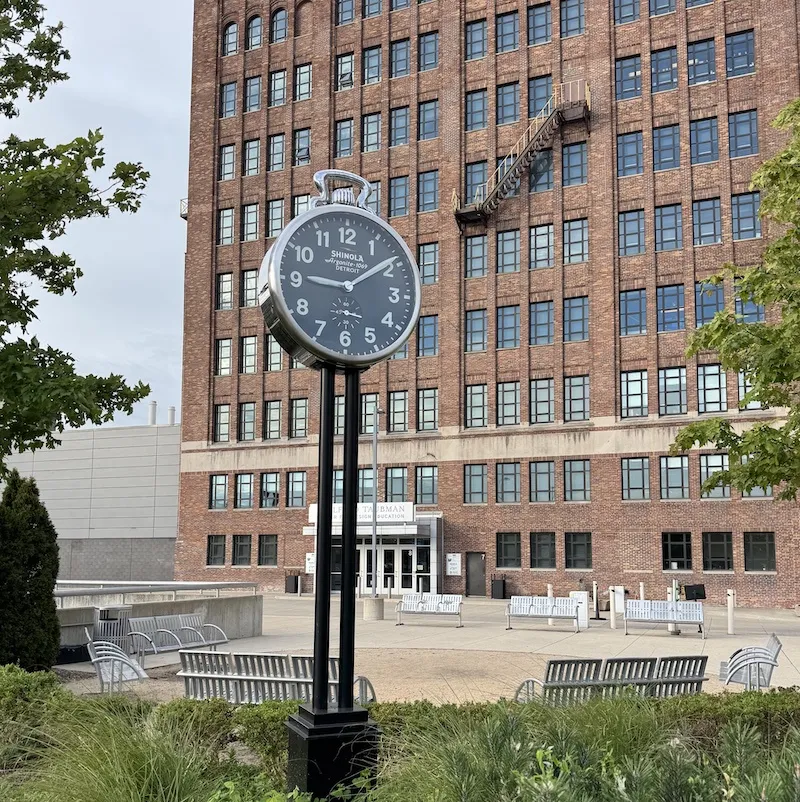
When you walk into Shinola’s factory in Detroit, one of the first things you notice is the smell of leather.
Located on the fifth floor of the historic Argonaut Building, Shinola’s Detroit factory includes watch assembly facilities, a leather workshop, quality-control areas, product-development space, and an in-house photography studio.
I recently visited the factory to see how Shinola watches and leather straps are made. For Hingham Jewelers, these visits are about more than satisfying personal curiosity. We believe that if we are going to recommend a product to our clients, we should understand where it comes from, who makes it, and what goes into producing it.
Shinola watches: Key facts
-Shinola watches are assembled and tested in Detroit.
-The watches use Swiss and other imported components.
-Many Shinola leather straps are sewn in the Detroit factory.
-Quartz movements are assembled in Detroit by trained specialists.
-Automatic movements are sourced internationally, including from Switzerland and Japan.
-Shinola recommends servicing automatic watches approximately every five years and quartz watches approximately every seven years.
-The factory also participates in product development, design review, photography, and quality control.
How Shinola leather watch straps are made
My first stop was Shinola’s leather strap workshop.
A team of approximately a dozen specialists worked along an assembly line, with each person responsible for a highly specific part of the process. One person applied heated adhesive to bond the layers of leather. Others performed paint touch-ups, installed the keepers, stitched the straps, applied stamps, attached buckles, and completed final quality-control checks.
Each task was small, but the finished strap depended on every step being performed consistently.
During the visit, I was told that approximately 80–90% of Shinola’s watch straps are sewn in Detroit, primarily using domestic leather.
A leather watch strap may appear simple when it is attached to a finished watch, but its comfort and durability depend on material selection, layering, stitching, finishing, and inspection.
That is one of the reasons it was valuable to see the process in person. The strap is not an afterthought. It is an important part of how the watch feels and wears over time.
Inside Shinola’s Detroit watch assembly floor
From the leather workshop, I moved to the watch factory floor.
There are several assembly lines, depending on the movement and the model being produced. Watches are assembled and tested in Detroit, while the components and movements come from a global supply chain.
The quartz movement assembly process was particularly interesting to watch. A small team of highly trained specialists works with tiny components, carefully placing each part into the movement. During my visit, I was told that assembling a quartz movement can take approximately 20 minutes before the watch moves on to testing and quality control.
The process is highly precise. The watch is not simply placed into a case and shipped. It is checked for operation, accuracy, and overall quality before leaving the factory.
And Shinola is particularly proud of the locals doing this work. Most of the experts working in this factory were trained in-house, with little prior watchmaking experience. They come from a variety of backgrounds, honing their skills and continuing a proud legacy of American manufacturing.
Why a watch’s seal and lubrication matter
One of the more technical conversations during my visit involved how the watches are sealed.
A watch’s case seal helps protect the movement from moisture, dust, and other contaminants. The factory team explained that Shinola pays close attention to both the quality of the oils used inside the movement and the integrity of the watch’s seal. Shinola wants that strong seal to last as long as possible to preserve the oil.
As lubricants inside a movement eventually dry out or deteriorate, the watch may need to be serviced to continue operating properly.
-Servicing automatic watches approximately every five years
-Servicing quartz watches approximately every seven years
-Replacing batteries approximately every one to three years
Are Shinola movements Swiss, Japanese, or American?
Shinola’s quartz movements are assembled in Detroit, while its automatic movements are sourced from international movement manufacturers, including Switzerland and Japan.
That arrangement is common throughout the watch industry. A modern watch movement consists of many highly specialized components, and producing those parts requires enormous precision and consistent supply.
During the visit, Shinola’s factory leadership explained that the company continues to explore how it might bring more movement production in-house. The challenge is finding enough components of sufficiently high quality to support production at scale.
Japanese movements have also helped Shinola respond to growing interest in automatic watches at more accessible price points.
A preview of Shinola’s future watches
I also received a preview of several watches currently in development.
Some may eventually become part of Shinola’s collection, but they still need to pass through design reviews and other stages of development.
New designs must be evaluated, refined, tested, and approved before they reach a showroom.
Shinola also maintains an in-house photography studio, allowing the company to photograph many of its watches and products internally. That gives the design and product teams greater control over how each piece is presented.
Why we visit the places behind the products we sell
The Shinola visit is part of a larger effort to understand the products and materials we work with.
I have traveled to Colombia to learn more about emerald mining, sourcing, and quality. I’ve visited South Africa to better understand diamond production and the journey from rough diamond to polished stone. In Antwerp, I studied diamond regulation, customs screening, traceability, and international oversight. I've also visited jewelry manufacturers in Providence to see how some of the jewels in our showcases are made here in New England. That includes casting, fabrication, stone setting, polishing, and final inspection.
Each trip offers a different perspective.
Our responsibility is to understand the jewelry and watch journey as thoroughly as possible and make that knowledge useful to our clients.
Craftsmanship is still about people
The most memorable part of visiting Shinola was not a particular machine or technical process. It was the people.
The factory had a friendly, relaxed atmosphere and a strong sense of Detroit pride. There was genuine enthusiasm about manufacturing in the city and about building products there at a time when many companies have moved production elsewhere.
That spirit felt familiar to me as the third-generation owner of a family jewelry business. Hingham Jewelers has been part of the South Shore community since 1948, and we understand the value of keeping knowledge, craftsmanship, and relationships close to home.
Whether we are discussing a diamond from South Africa, an emerald from Colombia, a watch assembled in Detroit, or a custom ring made by a local goldsmith, the same principle applies.
The more we understand about how something is made, the better we can help our clients decide whether it is right for them.
The story behind a product should be more than a marketing phrase. It should be something we have taken the time to see for ourselves.
We can't wait to show you our Shinola watch selection during your next visit!
-Michael
President, Hingham Jewelers
Frequently asked questions about Shinola watches
Are Shinola watches made in America?
Shinola watches are assembled and tested in Detroit using Swiss and other imported components. They are not made entirely from American parts, but significant assembly, quality control, training, design, and manufacturing work take place in Detroit.
Where are Shinola watches assembled?
Shinola watches are assembled at the company’s factory in the historic Argonaut Building in Detroit, Michigan.
Are Shinola watch movements Swiss or Japanese?
Shinola uses different movements depending on the watch model. Quartz movements are assembled in Detroit, while automatic movements are sourced internationally, including from Switzerland and Japan.
Are Shinola leather straps made in Detroit?
Many Shinola leather straps are sewn in the company’s Detroit leather studio. During our visit, we were told that approximately 80–90% of Shinola’s straps are sewn there.
How often should a Shinola watch be serviced?
Shinola recommends servicing automatic watches approximately every five years and quartz watches approximately every seven years. Batteries are generally recommended every two to three years.
Can Shinola watches be repaired?
Yes. Shinola offers repair and service support for its watches, and Hingham Jewelers can help clients understand service needs and the appropriate next step.
Why did Hingham Jewelers visit the Shinola factory?
We visit factories, workshops, mines, and sourcing centers so we can better understand the products we recommend. Seeing how a product is made allows us to give clients more informed, transparent advice.